
South Carolina Criminal Records
South Carolina criminal records are public documents held by the State Law Enforcement Division, county courts, and local agencies across all 46 counties. SLED serves as the central repository for criminal history information in South Carolina. You can search criminal records through the SLED CATCH portal, the SC Judicial Branch Public Index, and county-level systems. This guide covers every official channel for finding South Carolina criminal records, explains what those records contain, and outlines how state public access laws apply to criminal history searches.
South Carolina Criminal Records Quick Facts
SLED CATCH: South Carolina Criminal History Search
The South Carolina Law Enforcement Division operates the primary statewide criminal history search system. Known as CATCH, which stands for Citizens Access to Criminal Histories, the portal lets anyone run a name-based search for South Carolina criminal records. SLED serves as the central repository for all criminal records in the state and can provide detailed in-state criminal histories. The SLED CATCH portal is the starting point for most criminal record searches in South Carolina.
Online searches through SLED CATCH cost $25.00 per record, plus a $1.00 convenience fee for the online transaction. Mail-in requests carry the same $25.00 fee but no convenience charge. For charitable organizations that qualify under S.C. Code Ann. § 23-3-115, the fee is reduced to $8.00. Public school districts receive criminal records checks for prospective and substitute teachers at no charge under the same statute. To submit a mail-in request, send the Criminal Record Check Form with proper payment to SLED Records Department, PO Box 21398, Columbia SC 29221-1398. Include a self-addressed stamped envelope with each mail request.
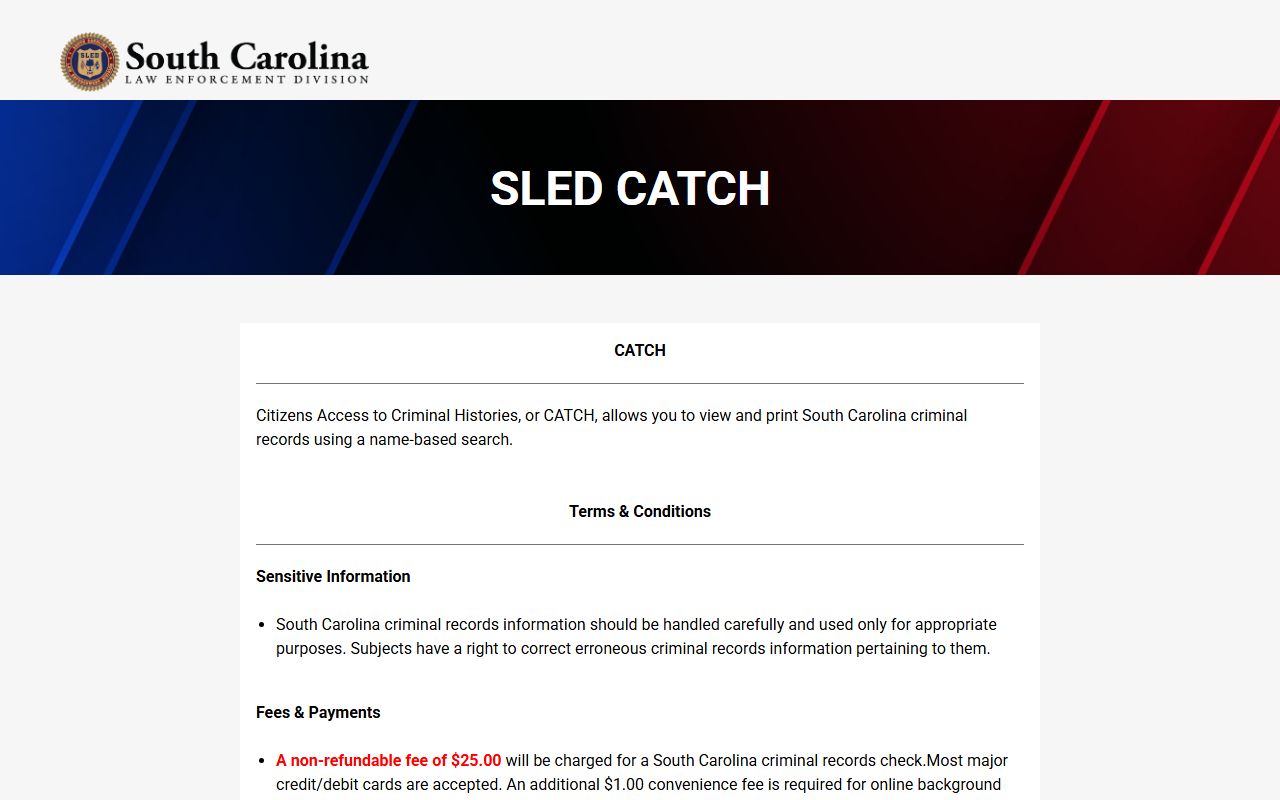
SLED CATCH runs a name-based search only. The system requires a starts-with match on last name, first name, and date of birth. A Social Security Number may also be searched if provided. Fingerprint-based searches are more reliable and less likely to return false results, but they require a separate process. SLED CATCH does not include wanted persons or sex offender registry information. Those searches use separate portals. The SLED Records Section has been closed to in-person visits since December 15, 2008. Call the SLED Public Dissemination Unit at 803.896.1443 between 9am and 4:30pm, Monday through Friday, with questions about search results.
Note: Expunged records will not appear in any SLED CATCH search result in South Carolina.
South Carolina Court Records Search
The South Carolina Judicial Branch provides free public access to criminal court records through its online Case Records Search database. This system covers all 46 counties and allows searches by county, defendant name, or case number. The SC Courts Case Records Search is maintained by the state and updated daily. A Public Index record shows the defendant name, case number, court and judge, filing date, charge description, disposition date, and type of disposition. Starting January 1, 2026, home address information is no longer displayed on the public index for any cases, old or new.
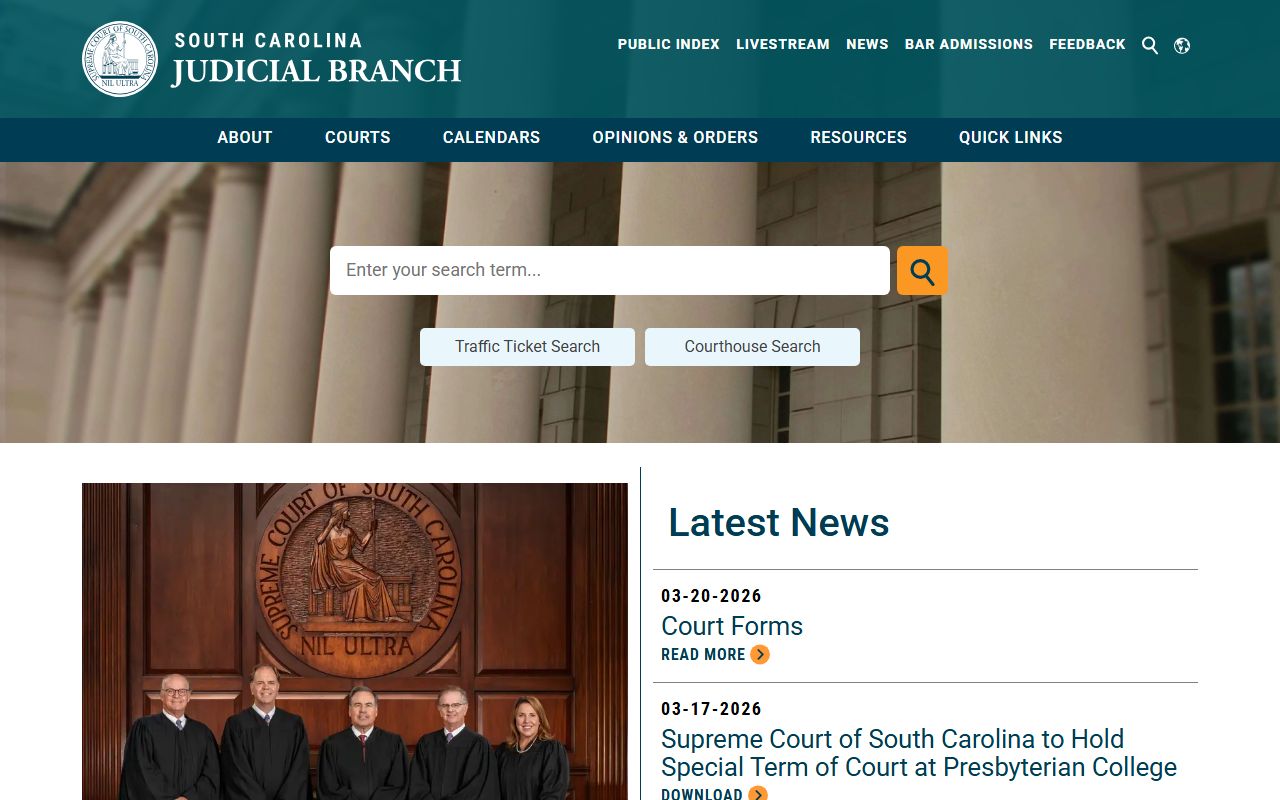
Each case record includes an Action tab with scheduled payment agreement details and a Financials tab showing any outstanding fines and fees from the sentence. Some municipal court records are also available in the public index system. The search requires a browser that supports cookies and JavaScript. For appellate court cases, use the C-Track Public Access portal, which covers South Carolina Supreme Court and Court of Appeals cases filed on or after May 1, 2012. The SC Judicial Branch website at sccourts.org also has a county courthouse search tool with addresses and phone numbers for all Clerk of Court offices.
SCDC Inmate Search for South Carolina
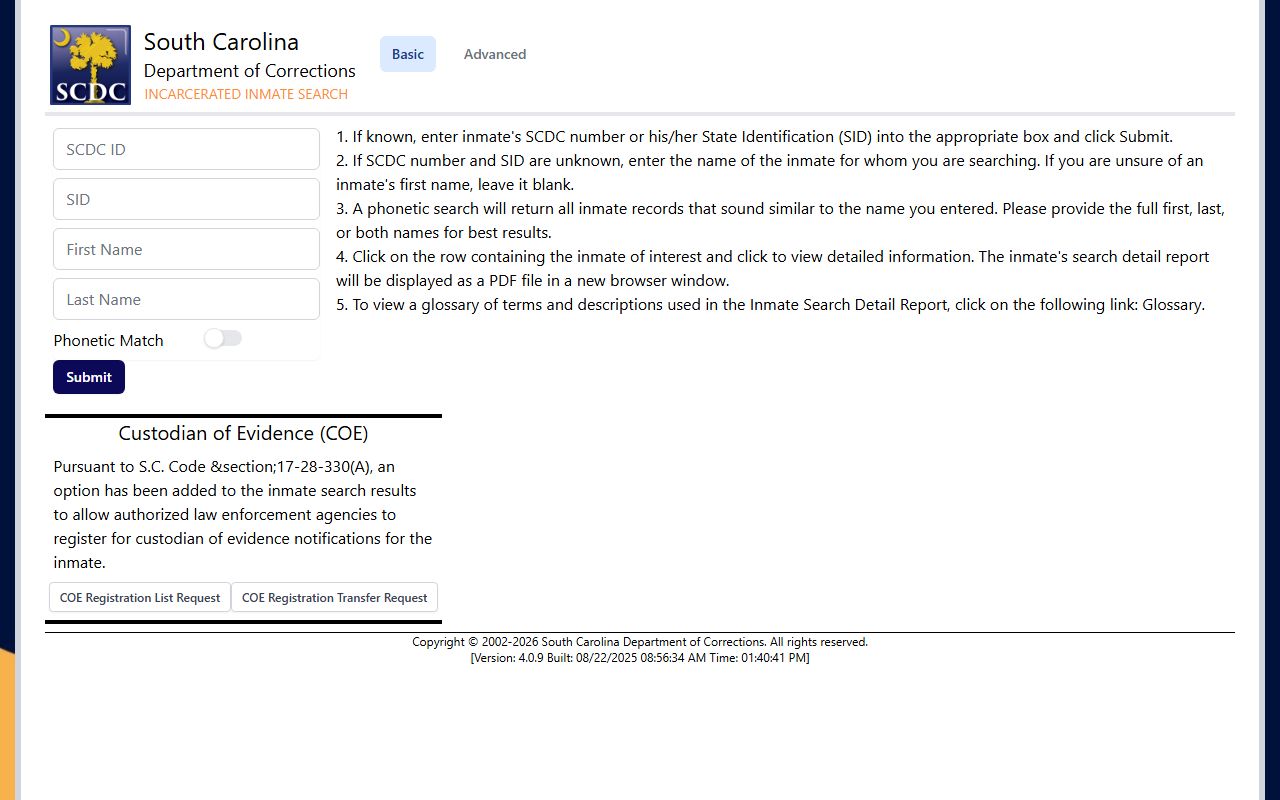
The South Carolina Department of Corrections runs a free online inmate search for people currently incarcerated in state prisons. You can search the SCDC inmate database by full name, SCDC number, or State Identification number. Results show photographs and public information on each inmate sentenced to and held at SCDC facilities. If you do not know the SCDC number or SID, try a name-only search and leave the first name blank if unsure of it.
For questions about an inmate, contact the SCDC Ombudsman at Ombudsman@doc.sc.gov or by phone at (803) 896-9409. FOIA requests to SCDC can be sent to FOIA@doc.sc.gov. Under S.C. Code Ann. § 30-4-10, the right to inspect public records does not extend to individuals who are currently serving a prison sentence in a state, county, or federal correctional facility.
South Carolina Sex Offender Registry
South Carolina maintains a public sex offender registry through SLED. The registry runs on SORT, the Sex Offender Registry Tracking system, provided at no cost by the U.S. Department of Justice. Search the South Carolina Sex Offender Registry for free at any time. SORT includes multiple photographs of each offender over time, a visual map of where they live, alias names, and all sex-related convictions on record.
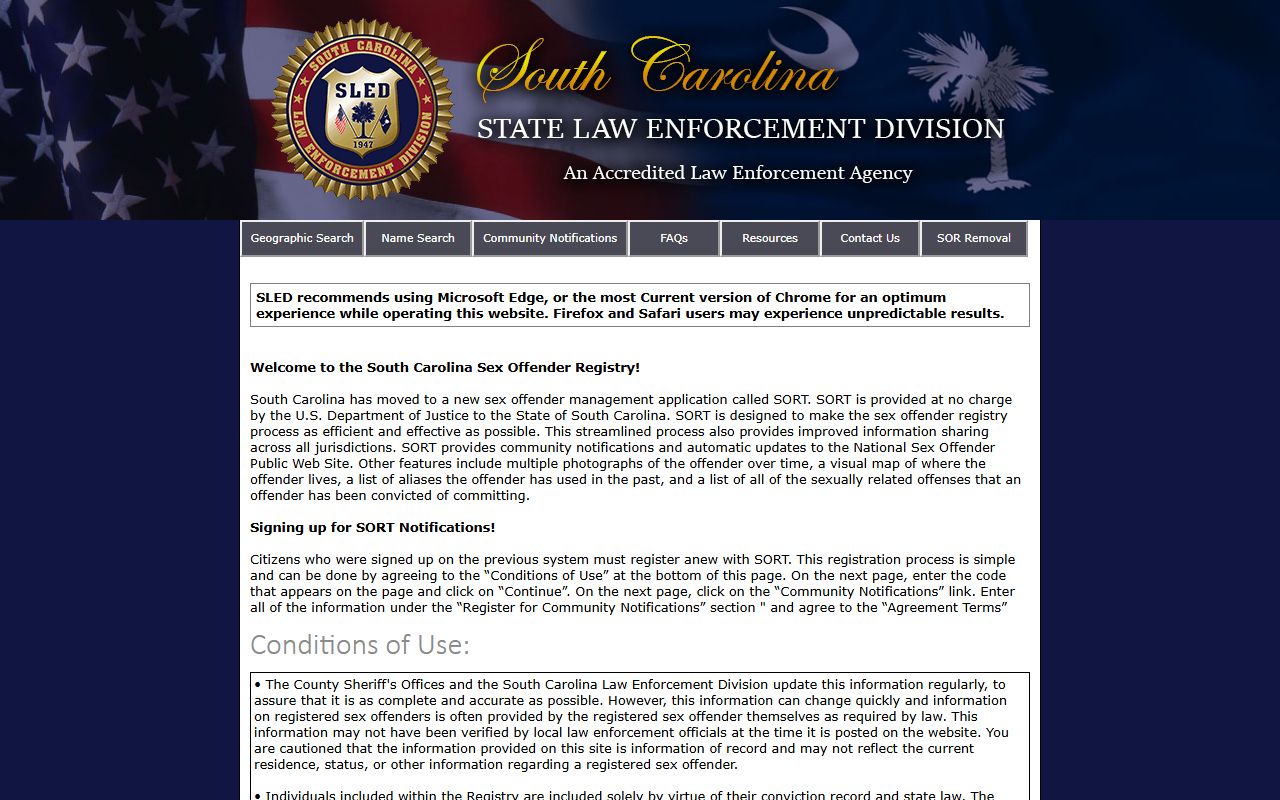
County sheriffs and SLED update the registry regularly. Under S.C. Code Ann. § 23-3-490, a sheriff or SLED must release registry information to any member of the public who requests it in writing or by electronic means. The information provided includes full names, aliases, physical characteristics, date of birth, home address, the offense requiring registration, and the date, city, and state of conviction. A photocopy of a current photograph must also be provided. This registry is separate from the SLED CATCH criminal history system.
Probation, Parole, and Pardon Services
The South Carolina Department of Probation, Parole and Pardon Services supervises offenders in the community. The agency's mission is to prepare offenders to become productive members of the community, provide assistance to crime victims and the courts, and protect public trust and safety. Visit ppp.sc.gov to learn about supervision programs and offender services. Contact SCDPPPS between 8:30 a.m. and 5:00 p.m. at (803) 734-9220, or call (800) 263-7191 after hours.
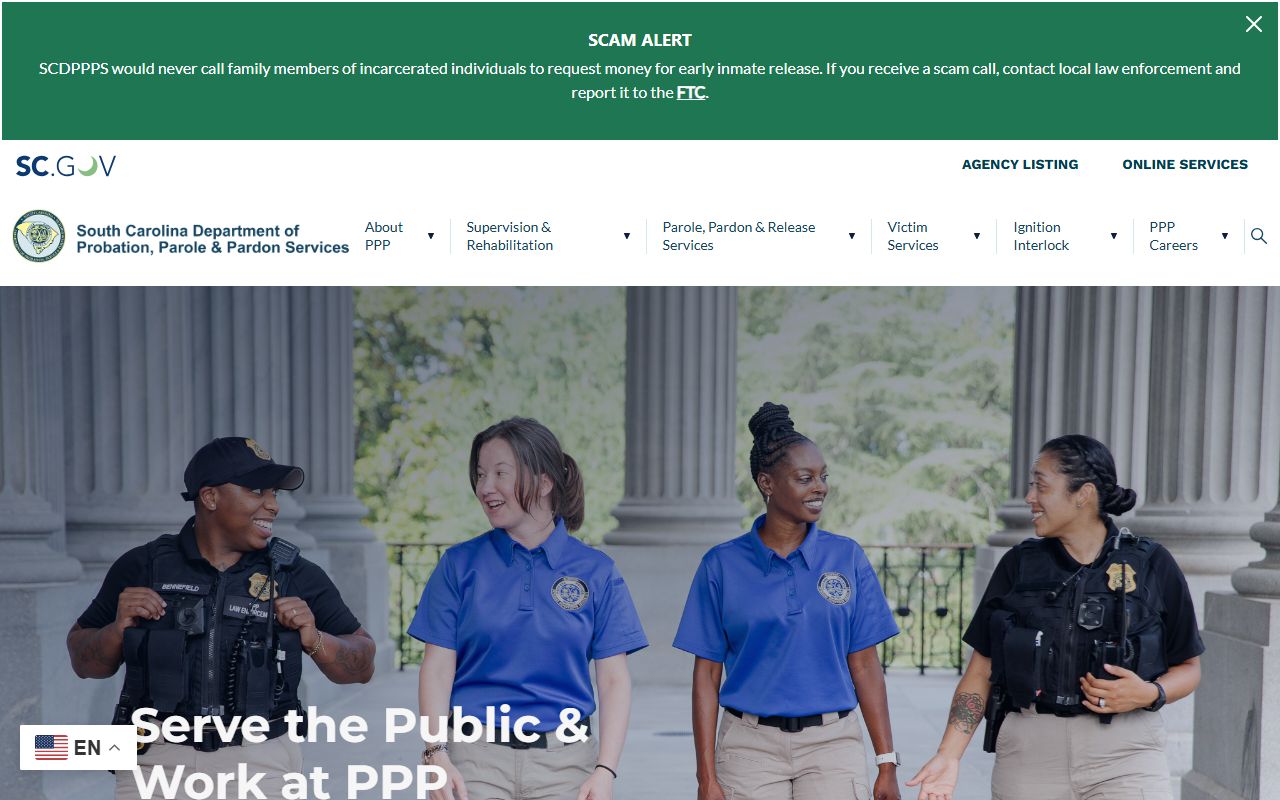
SCDPPPS has issued warnings about scammers who target families of convicted offenders by pretending to be agency staff. The department will never demand payment over the phone. If you receive a suspicious call, contact the agency directly to verify. The Statewide Automated Victim Information and Notification system, known as SAVIN, provides free notifications to crime victims about offender custody status changes throughout South Carolina.
Appellate Court Criminal Records in South Carolina
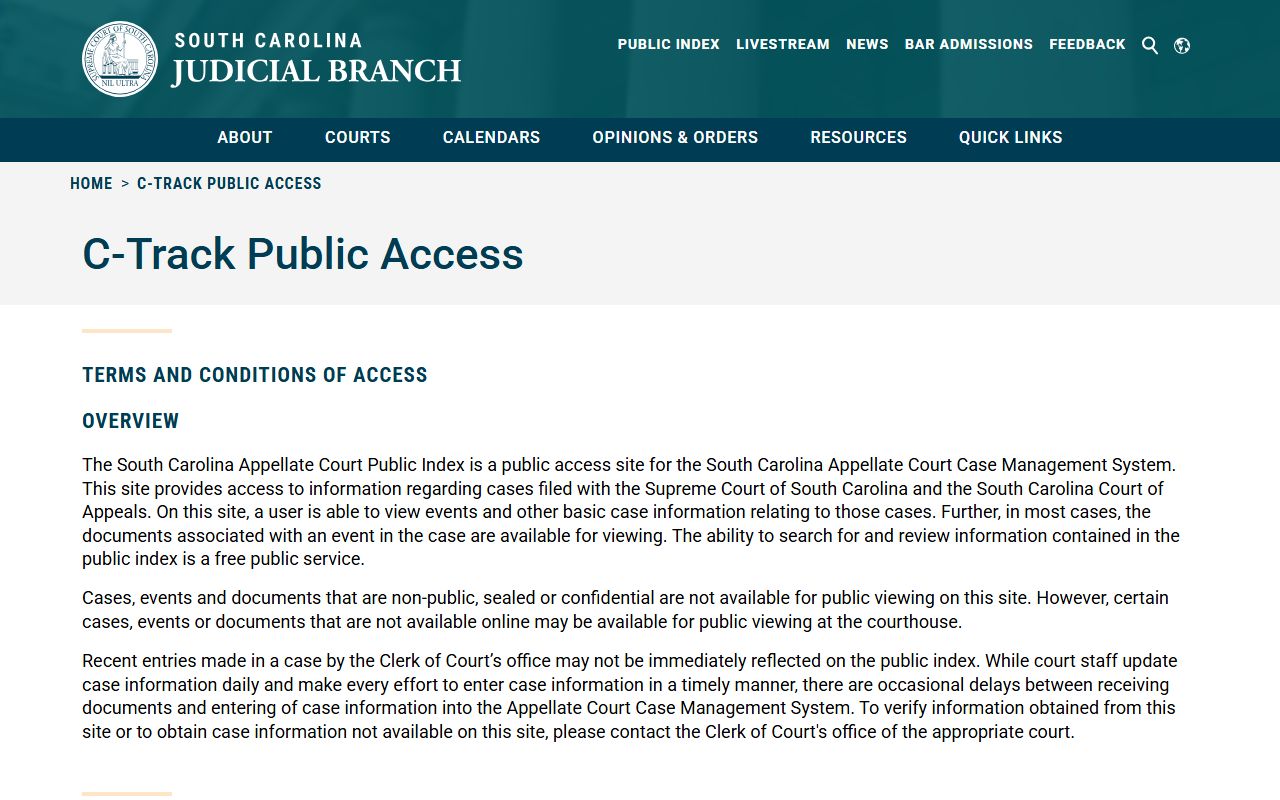
Criminal cases that reach the South Carolina Court of Appeals or the Supreme Court are searchable through the C-Track Public Access portal at sccourts.org. This free service shows case events, documents, and basic information for appellate proceedings. Cases sealed or marked confidential by the court are not available for public viewing. Records on this system are generally only available for cases filed or pending on or after May 1, 2012.
Federal Criminal Records for South Carolina
Federal criminal cases involving South Carolina defendants are handled by the U.S. District Court for South Carolina. In 1965, South Carolina was consolidated into one U.S. District Court. Criminal cases filed from September 1992 to the present are available through the PACER system. Older records, including cases filed before 1981, are housed at the Federal Records Center in East Point, Georgia.
All records in the federal Clerk's Office are filed and retrieved by case number. If the case number is unknown, staff can search the party index. Walk-in access to the party index is available Monday through Friday from 9:00 a.m. to 4:30 p.m. at staffed offices in Charleston, Columbia, Florence, and Greenville. If the Clerk's Office conducts a name search for you, the fee is $34.00 per name, payable in advance. All search requests must be submitted in writing with the appropriate fee. Visit scd.uscourts.gov for more on federal criminal cases in South Carolina.
Expungement of South Carolina Criminal Records
South Carolina law allows certain criminal records to be expunged, meaning destroyed or sealed from public access. Under S.C. Code Ann. § 17-22-910, all expungement applications are administered by the circuit solicitor's office in the judicial circuit where the charge originated. Eligibility depends on the offense the person was convicted of or pled guilty to, not on the charge originally filed. This provision also applies retroactively.
Expungement-eligible offenses in South Carolina include first-offense misdemeanors in magistrate court, conditional discharge cases, certain first-offense drug possession convictions, pretrial intervention completions, and charges that were dismissed, acquitted, or nolle prossed. Under S.C. Code Ann. § 17-1-40, a destruction order restores the person, in the eyes of the law, to the status they held before the arrest. No record of the charge may be retained by any municipal, county, or state entity after a destruction order is entered. Fees for expungement include a $250 administrative fee to the solicitor's office, a $25 SLED verification fee, and a $35 clerk of court filing fee. The $250 fee is nonrefundable.
South Carolina Criminal Records Laws
South Carolina law governs who can access criminal records, how they are maintained, and what rights individuals have to challenge or clear those records. The state's Freedom of Information Act, found at S.C. Code Ann. § 30-4-10 et seq., gives citizens the right to inspect, copy, or receive an electronic transmission of any public record. The General Assembly found that open access to public records is vital in a democratic society. Certain records are exempt from disclosure under S.C. Code Ann. § 30-4-40, including law enforcement records that could interfere with a pending investigation, reveal a confidential source, or constitute an unreasonable invasion of privacy.
Under S.C. Code Ann. § 23-3-120, all law enforcement agencies and court officials must report criminal data and related information to the SLED Central Record Repository. Anyone arrested in South Carolina must be fingerprinted at booking, and those fingerprints must be submitted to SLED within three days. SLED's Uniform Crime Reporting Department collects and disseminates crime data from all law enforcement agencies in the state. Juvenile records are generally sealed and confidential under S.C. Code Ann. § 63-19-2010, with limited exceptions for serious offenses. The sale or dissemination of the criminal history record database maintained by SLED is prohibited by state law.
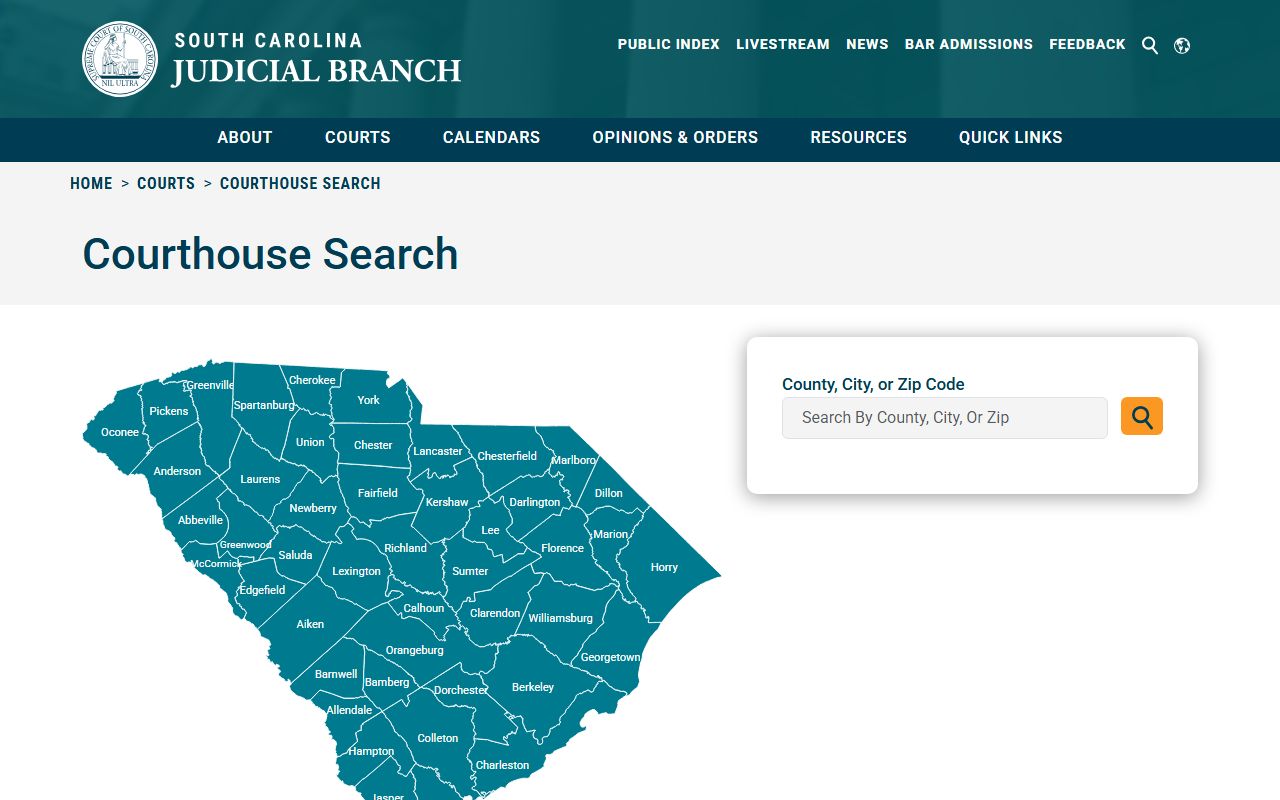
To find the Clerk of Court office for any of South Carolina's 46 counties, use the SC Courts courthouse search tool. Each county's Clerk of Court maintains circuit court and family court records and can provide copies of criminal case documents. Most offices are open Monday through Friday from 8:30 a.m. to 5:00 p.m.
Note: Criminal records checks done through SLED CATCH cover South Carolina records only. National checks require a separate FBI fingerprint-based process.
South Carolina Criminal Records by County
Each of South Carolina's 46 counties maintains criminal court records through the Clerk of Court. Pick a county below to find local resources, contact information, and search options for criminal records in that area.
Criminal Records in Major South Carolina Cities
Residents of South Carolina's major cities can access criminal records through their city police department and the county systems that serve their area. Pick a city below to find local resources.