
Charleston County Criminal Records
Charleston County criminal records are maintained by the Clerk of Court and accessible through the South Carolina Public Index, the SLED CATCH statewide portal, and direct requests to county agencies. One of South Carolina's most populous counties, Charleston has one of the largest full-service Sheriff's Offices in the state, a busy Circuit Court with an active General Sessions docket, and detailed online access tools for public record research. Whether you need arrest history, felony case records, or a comprehensive statewide background check, Charleston County offers multiple reliable channels for obtaining that information.
Charleston County Quick Facts
Charleston County Criminal Records at the Clerk of Court
The Charleston County Clerk of Court maintains official criminal court records for all cases processed through the Circuit Court. The Clerk's office handles criminal and civil case records, processes legal actions, and schedules jury and non-jury trials. For criminal history research, the Clerk is the authoritative source for General Sessions case files, certified copies, and detailed case documentation. Contact information for the Clerk's office is available through the Charleston County government website at charlestoncounty.org, or by email at clerkofcourt@charlestoncounty.org.
The Charleston County Public Index on the SC Courts platform provides free name-based and case-number searches for criminal and civil cases. This is the most efficient starting point for most record research needs. As of March 2026, document image availability on the county's own site may be intermittent due to ongoing system updates. The Public Index on the SC Courts platform remains a reliable alternative during these periods.
Under S.C. Code Ann. § 30-4-10, Charleston County criminal court records are public records. Any person may request to inspect or copy them. Requests can be submitted in person at the Clerk's office or by mail. Given Charleston County's large population and active court docket, providing specific identifying information such as the subject's full name, date of birth, and approximate case dates reduces processing time considerably.
Charleston County General Sessions handles all felony criminal prosecutions for the county. The volume of cases is among the highest in South Carolina. Researchers should anticipate that name-based searches may return multiple results, particularly for common names, and should use additional identifiers to confirm the correct record.
Charleston County Sheriff and Arrest Records
Sheriff Carl Ritchie, elected in November 2024, leads the Charleston County Sheriff's Office. The Sheriff's Office website is at sheriff.charlestoncounty.org. The office's mission is to serve the community by helping to provide a safe environment for citizens to live, work, and raise families. Charleston County has one of the largest full-service Sheriff's Offices in South Carolina, with accreditations from CALEA, the American Corrections Association, and the National Commission on Correctional Health Care.
The Sheriff has authority to enforce state law throughout Charleston County, including in incorporated areas. When a 9-1-1 call comes in, the call is automatically directed to the appropriate agency based on jurisdiction. This coordination means criminal cases originating anywhere in the county may come through either the Sheriff's Office or a municipal police department, though all felony prosecutions flow through the same Circuit Court General Sessions system.
The following image is from the Charleston County Clerk of Court page, showing the county facility where criminal records are maintained.
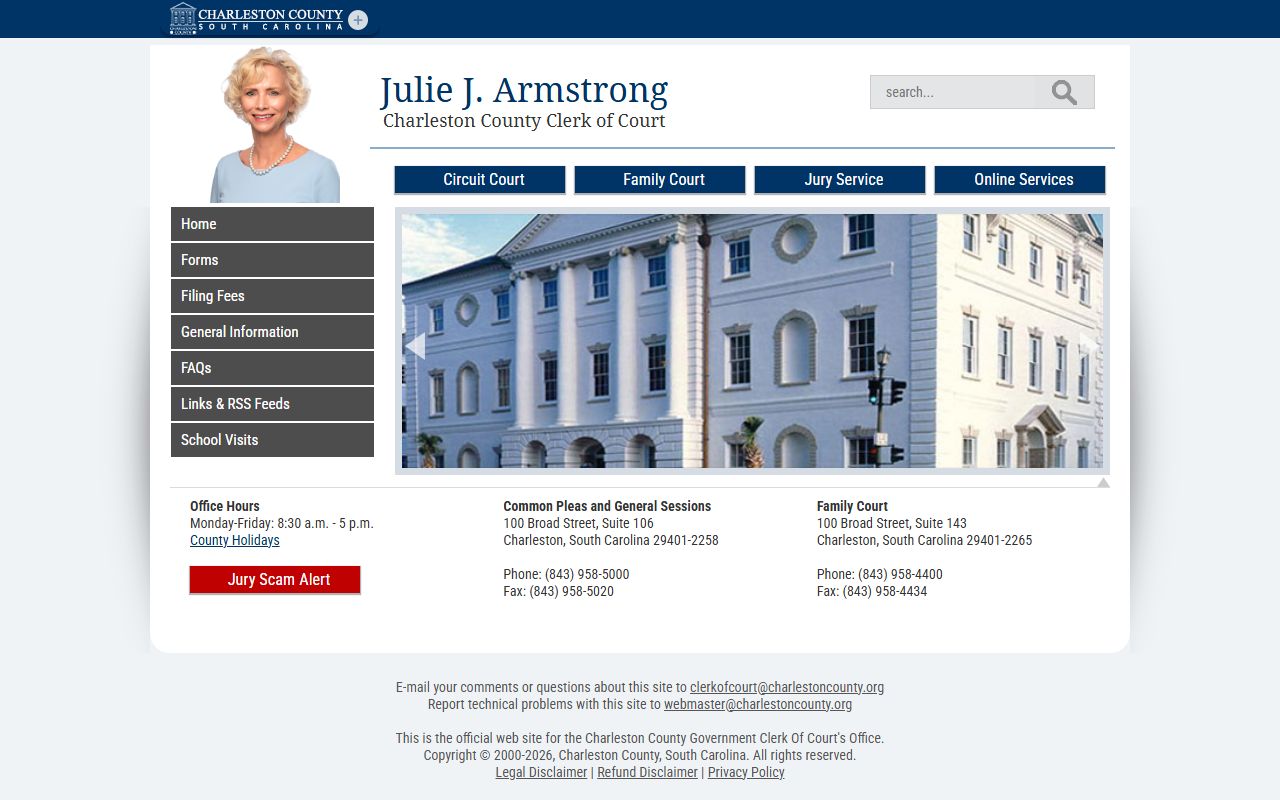
The Charleston County Clerk of Court maintains all General Sessions criminal case files and handles records requests from the public, attorneys, and authorized agencies.
The Charleston County Detention Center accommodates pre-trial detainees. Booking information including charges and bond amounts is available for recently detained individuals. Researchers looking for current detention records can contact the Detention Center directly or check the county's online inmate lookup tool when available. Case outcomes for individuals who move from the Detention Center through to court are reflected in General Sessions records.
Under S.C. Code Ann. § 30-4-40, certain active law enforcement records at the Charleston County Sheriff's Office may be withheld from disclosure. This exemption covers investigative files that could harm ongoing prosecutions or identify confidential informants. Closed case records are generally accessible through the Clerk of Court under FOIA.
Note: Municipal police departments in Charleston County, such as the Charleston Police Department, maintain their own arrest records independently from the Sheriff's Office.
SLED CATCH and Statewide Criminal History
The SLED CATCH portal at catch.sled.sc.gov provides comprehensive statewide criminal history that includes all Charleston County records reported to SLED. Under S.C. Code Ann. § 23-3-120, every law enforcement agency in South Carolina must report arrest and disposition data to SLED. This mandate means Charleston County records, from the Sheriff's Office and all municipal departments, flow into the statewide CATCH database. The search fee is $25.00 plus $1.00 online under S.C. Code Ann. § 23-3-115.
For individuals with criminal history in multiple South Carolina counties, CATCH provides a unified record that individual county searches cannot replicate. Charleston County residents who have also lived in other parts of South Carolina may have records distributed across multiple county indexes. CATCH captures them all in a single search.
SLED also hosts the South Carolina Sex Offender Registry, which is free to search. The SCDC inmate search covers all individuals in state correctional custody. The Probation, Parole, and Pardon Services site covers those on supervision. The SLED main website links to all of these tools.
What Charleston County Criminal Records Contain
Criminal records from Charleston County's General Sessions Court include the defendant's name and identifying information, the charges as indicted by the Grand Jury, all hearing dates and continuances, motions filed by counsel, and the final case disposition. Dispositions include guilty pleas, jury or bench trial verdicts, sentencing entries covering prison terms, fines, probation, and suspended sentences, dismissals, and nolle prosequi entries where the Solicitor elected not to proceed.
Magistrate Court records in Charleston County cover misdemeanor charges and traffic violations throughout the county. These cases are higher in volume and faster-moving than General Sessions matters. Records reflect fines, community service, short-term incarceration, or dismissals. Magistrate records are searchable through the Public Index and also feed into the SLED CATCH database through mandatory reporting.
The image below comes from the Charleston County Sheriff's Office, representing the law enforcement operations that generate arrest records in Charleston County.
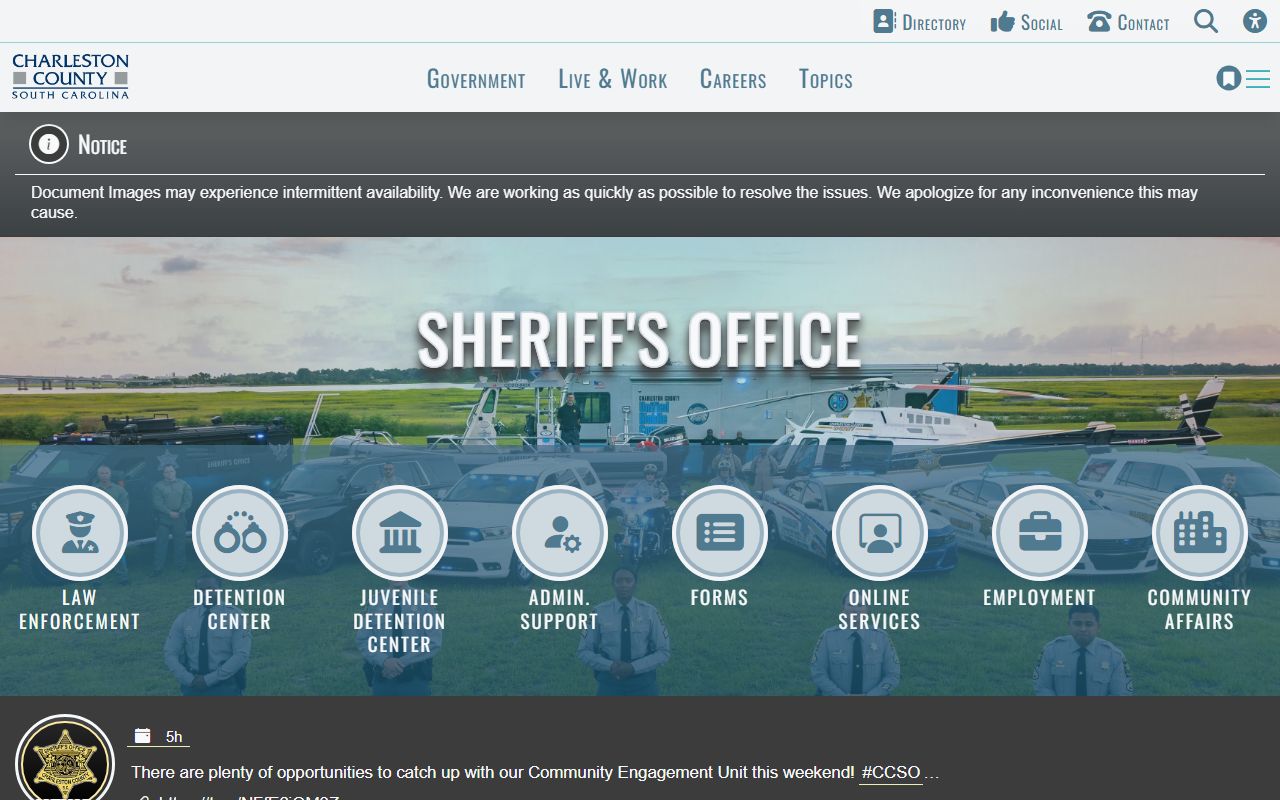
The Charleston County Sheriff's Office processes bookings and arrest records that ultimately feed into the Circuit Court criminal case system maintained by the Clerk of Court.
Under S.C. Code Ann. § 17-1-40, records for cases that ended in dismissal or acquittal may be subject to destruction. This protection ensures that individuals who were charged but not convicted are not permanently burdened with public records of unproven charges. Researchers should verify whether a specific arrest record still has a corresponding court record, as some may have been properly destroyed under this statute.
Juvenile records are strictly confidential under S.C. Code Ann. § 63-19-2010. Family Court juvenile proceedings in Charleston County are sealed and inaccessible through standard public records channels. Only authorized parties may access these files.
Expungement in Charleston County
South Carolina's expungement statute at S.C. Code Ann. § 17-22-910 provides a pathway for eligible Charleston County residents to clear qualifying criminal records from public access. A successful expungement removes records from the Public Index, the SLED CATCH system, and all government agency holdings. The Clerk of Court, the Sheriff's Office, and SLED are all directed to seal or destroy the covered records once a judge enters the expungement order.
Charleston County's large population and active court system mean a significant number of expungement applications are processed each year. Eligibility covers first-offense nonviolent misdemeanor dismissals and acquittals, certain first-time nonviolent felony convictions after completing all sentence requirements, and cases resolved through conditional discharge programs. The waiting period and specific conditions vary by charge type.
The application is filed with the Charleston County Clerk of Court. The Solicitor's Office reviews it and consents or objects. A circuit judge issues the final ruling. Charleston County's volume of expungement filings means applicants should plan for processing time. Working with an attorney familiar with the local court system can help ensure the application is complete and correctly submitted. The statute is at scstatehouse.gov/code/t17c022.php.
Public Records Law in Charleston County
South Carolina's FOIA at S.C. Code Ann. § 30-4-10 et seq. establishes the public right to inspect and copy Charleston County criminal court records. The ten-business-day response deadline under S.C. Code Ann. § 30-4-30 applies to all records requests. The full FOIA text is at scstatehouse.gov/code/t30c004.php. Charleston County processes a high volume of records requests given its large population, and providing detailed case information helps reduce delays.
Exemptions under S.C. Code Ann. § 30-4-40 cover active law enforcement investigative files, confidential informant records, and court-sealed documents. When a request is denied in part or in full, the agency must provide a written explanation identifying the specific exemption. General court records from closed cases are publicly accessible under FOIA. The Clerk of Court and the Sheriff's Office both maintain FOIA compliance procedures for handling public requests.
Charleston County's significant size means its criminal records infrastructure is more complex than most South Carolina counties. The SC Courts case records search provides statewide access that includes Charleston County data. Title 23 statutes governing SLED and criminal records are at scstatehouse.gov/code/t23c003.php. As of March 2026, document image availability on the county's own portal may be intermittent, making the SC Courts Public Index the more reliable backup option for online research.
Note: Researchers should confirm current system availability before relying on the county's own portal, as intermittent document image issues were noted in early 2026.
Nearby Counties
Charleston County borders several other Lowcountry counties. Criminal records in neighboring jurisdictions may be relevant for incidents near county lines.